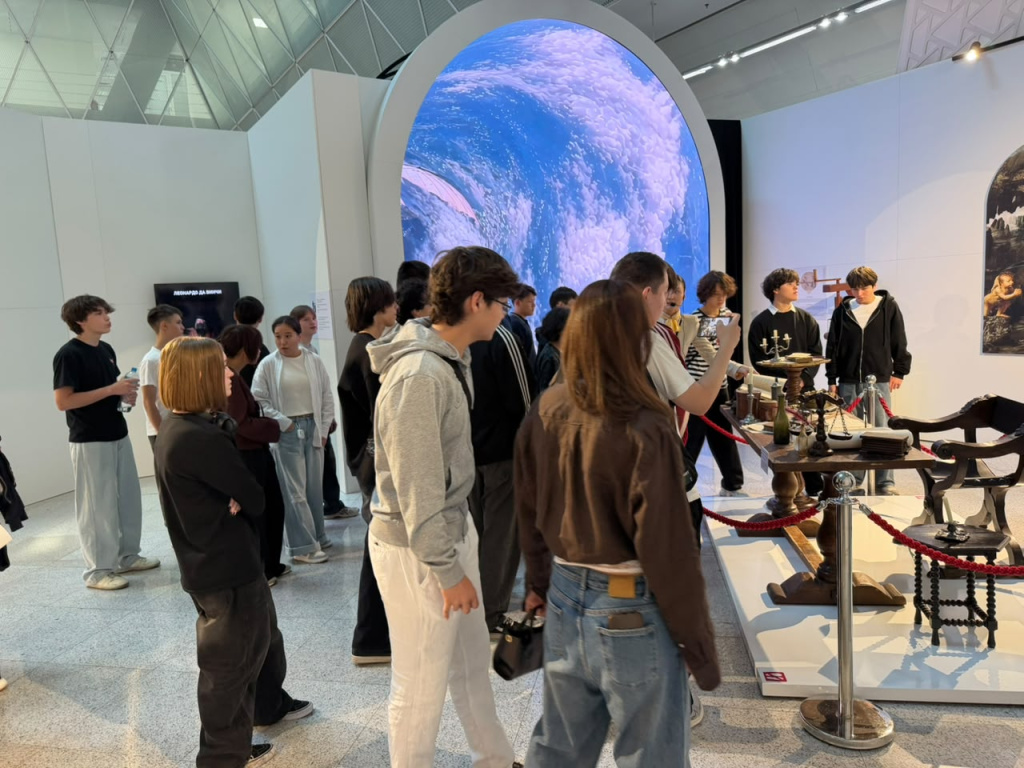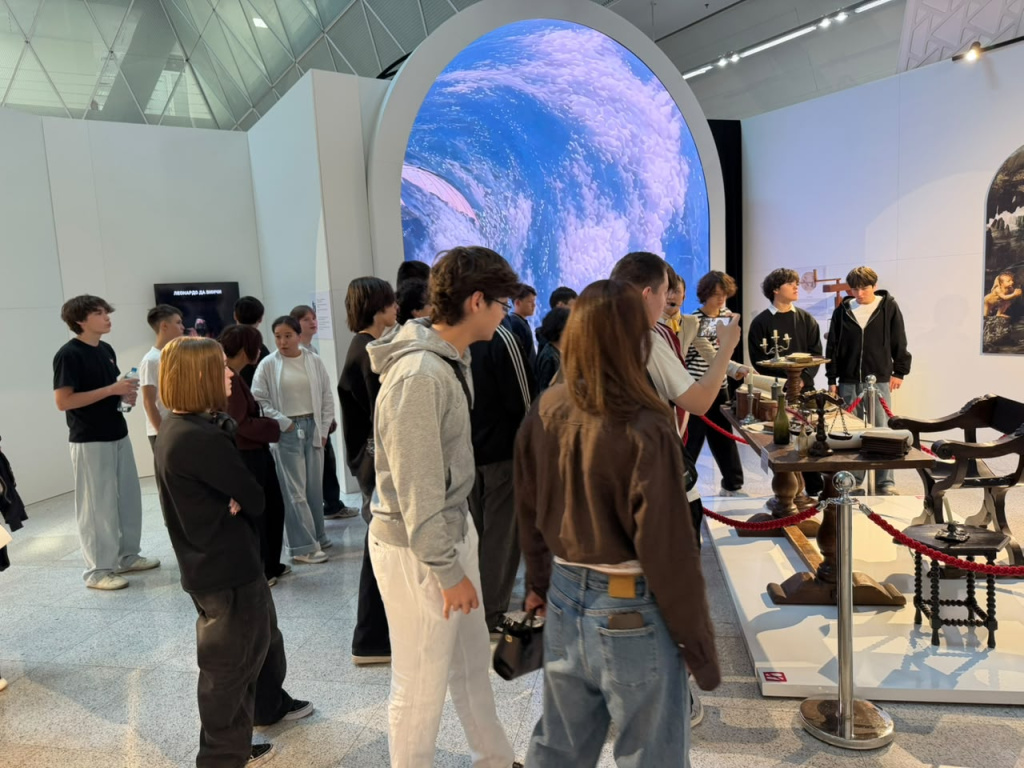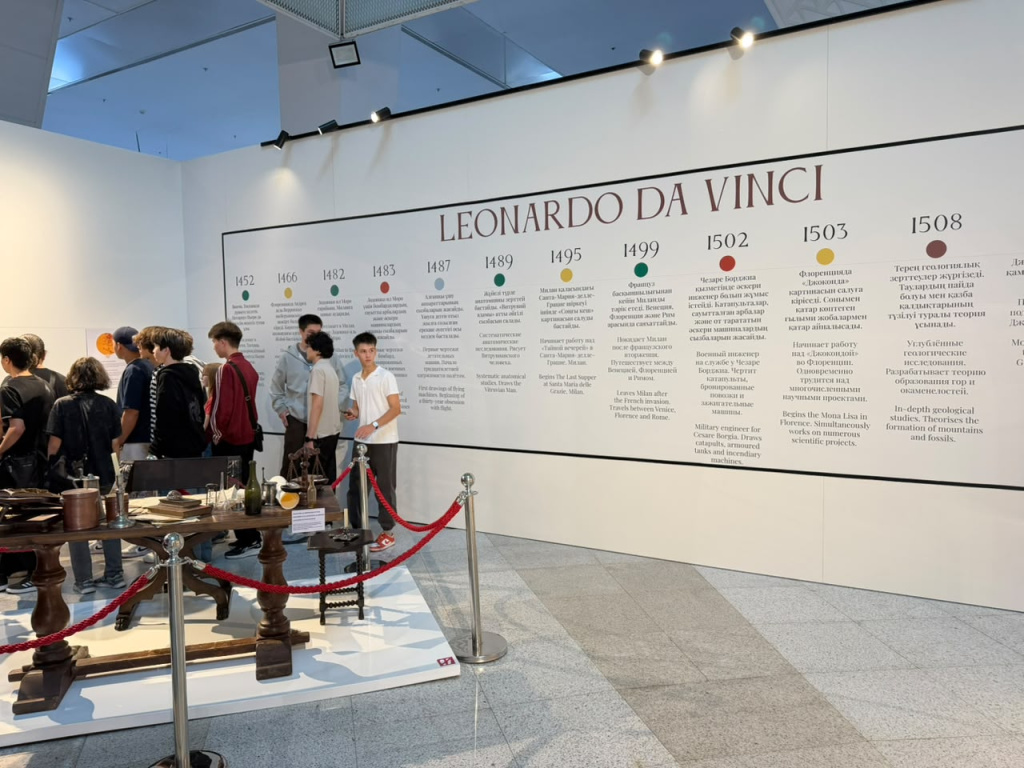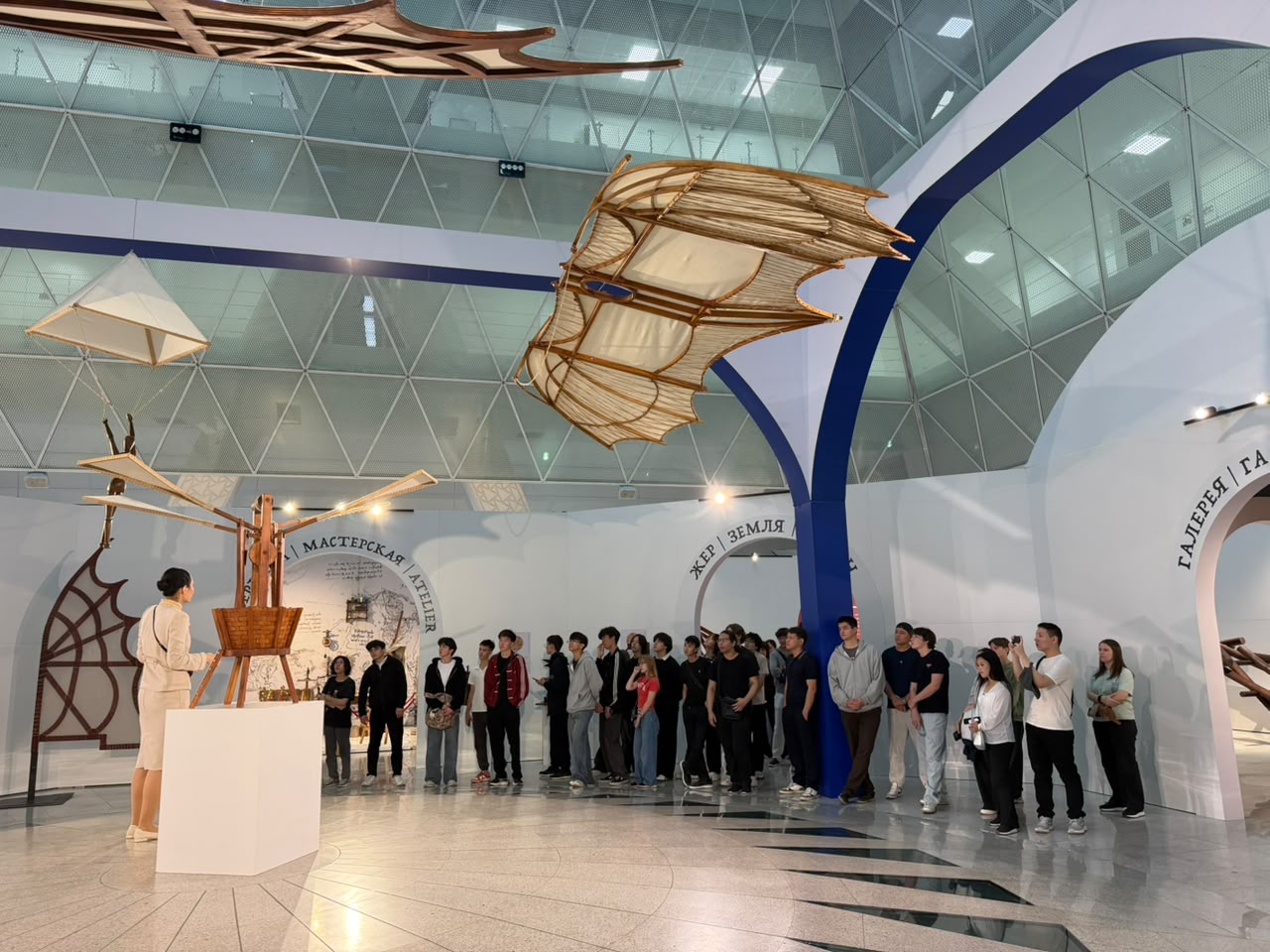
Students of the Pvr21 group held an off-site lesson of the Professional module “Creating individual elements of the graphical interface” at the Palace of Peace and Accord, visiting the famous Leonardo da Vinci exhibition!
The students visited a large-scale exhibition dedicated to the legacy of the great Florentine master. The exhibition allowed future jurists to see how Renaissance ideas are embodied in metal and light five centuries later.
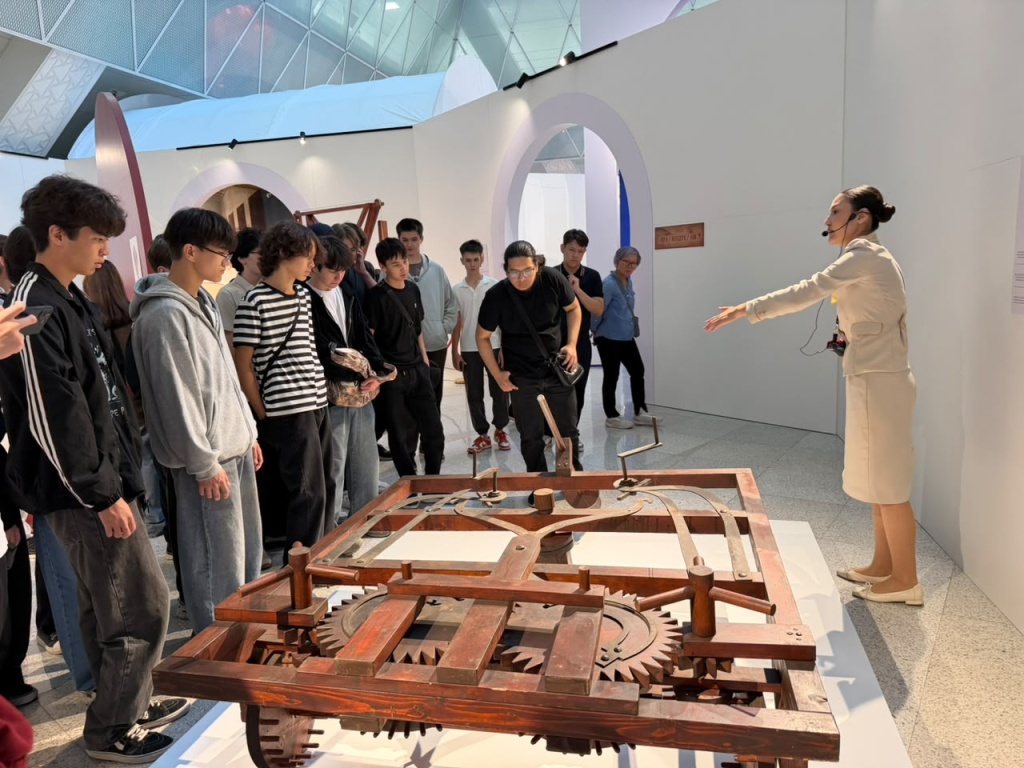
The central place at the exhibition is occupied by more than 40 full-size mechanical models and devices recreated by historians of science according to the original drawings and codes of Leonardo da Vinci. The visitors are presented with:
* flying vehicles: prototypes of an ornithopter (flywheel) and a prototype of a modern helicopter;
* Engineering vehicles: A self—propelled cart is one of the first car concepts, as well as complex block systems for moving heavy loads;
* Military equipment: a giant multi-shot crossbow, an armored tank and a trebuchet, clearly demonstrating the master’s engineering approach to protecting cities.
The students were particularly impressed by the modern multimedia areas. With the help of LED installations, digital projections and three-dimensional holograms, the organizers recreated the famous works of the master. “Fragments” of “”The Last Supper” “came to life” before the eyes of the audience, a digital model of the “Vitruvian Man” rotated in the air, and the portrait of the Mona Lisa changed depending on the viewing angle.
The exhibition space is divided into four thematic zones corresponding to the elements that the scientist studied.:
* Air: all flying machines are assembled here, from membrane wings to a pyramid-shaped parachute.
* Water: the area is dedicated to hydrodynamics, where you can study the design of a diving suit with a leather helmet and a breathing tube, as well as models of port facilities.
* Land: The space is devoted to machinery for agriculture, construction, and movement overland.
* Fire: This section is entirely dedicated to military engineering and the destructive power of the weapons invented by the master.
“It’s one thing to read about his inventions in textbooks on the history of technology, and quite another to see in front of you a working mechanism made of wood and metal, which you just turned with your own hands. The ornithopter was especially impressive: you begin to understand the train of thought of the designer, who was trying to solve the mystery of bird flight,” one of the visitors shares his impressions.
According to the curator of the group, such events play a key role in the professional development of future specialists.
“For our students of exact sciences, this is the best lesson in interdisciplinarity. The exhibition clearly shows that physics, mechanics, geometry and art are inextricably linked. This inspires them not to be afraid of bold hypotheses in their own course projects,” said the teacher.
The exhibition has become a visual aid for young people on the history of world engineering, proving that the laws of mechanics, discovered by the genius of the Renaissance, remain the foundation for any modern technology. The students left the exhibition with new ideas for their studies and deep respect for a man who was centuries ahead of his time.